
Ten years ago, “doing digital marketing” mostly meant ranking on Google, posting on Facebook and sending a newsletter. In 2026 the same job spans AI-generated search answers, short-form video, creator partnerships, automated ad platforms and email flows that run without anyone pressing send.
No single in-house marketer can be good at all of it. That gap is the real reason businesses hire agencies, and it’s a better reason than “we’re too busy.”
This guide explains what has changed, where an agency genuinely helps, where it doesn’t, and how businesses of different sizes can decide.
Why do businesses hire a digital marketing agency?
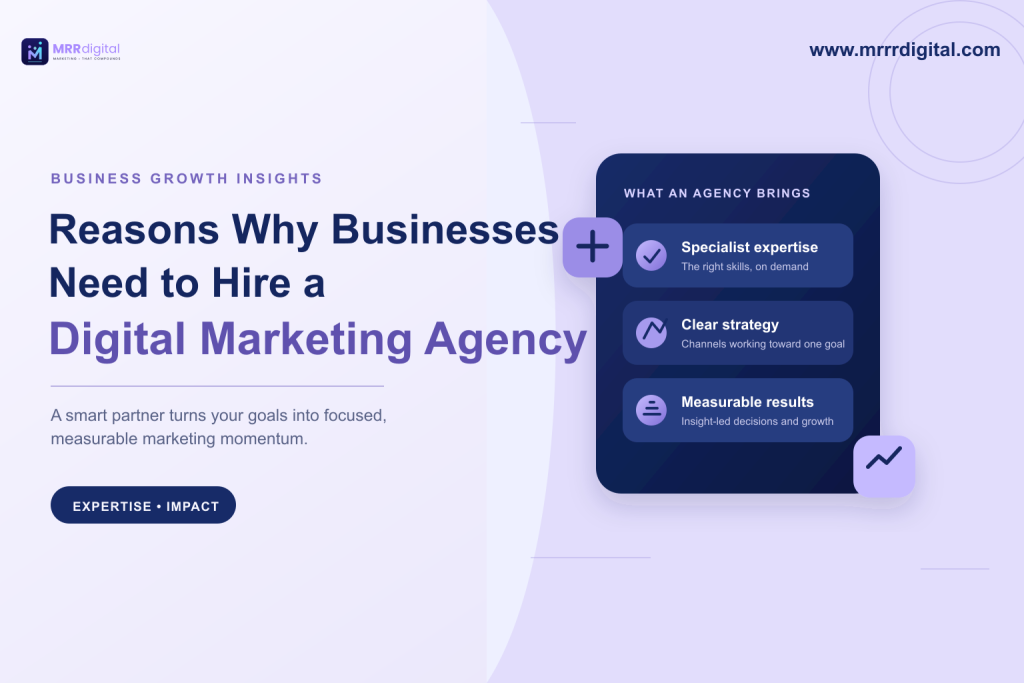
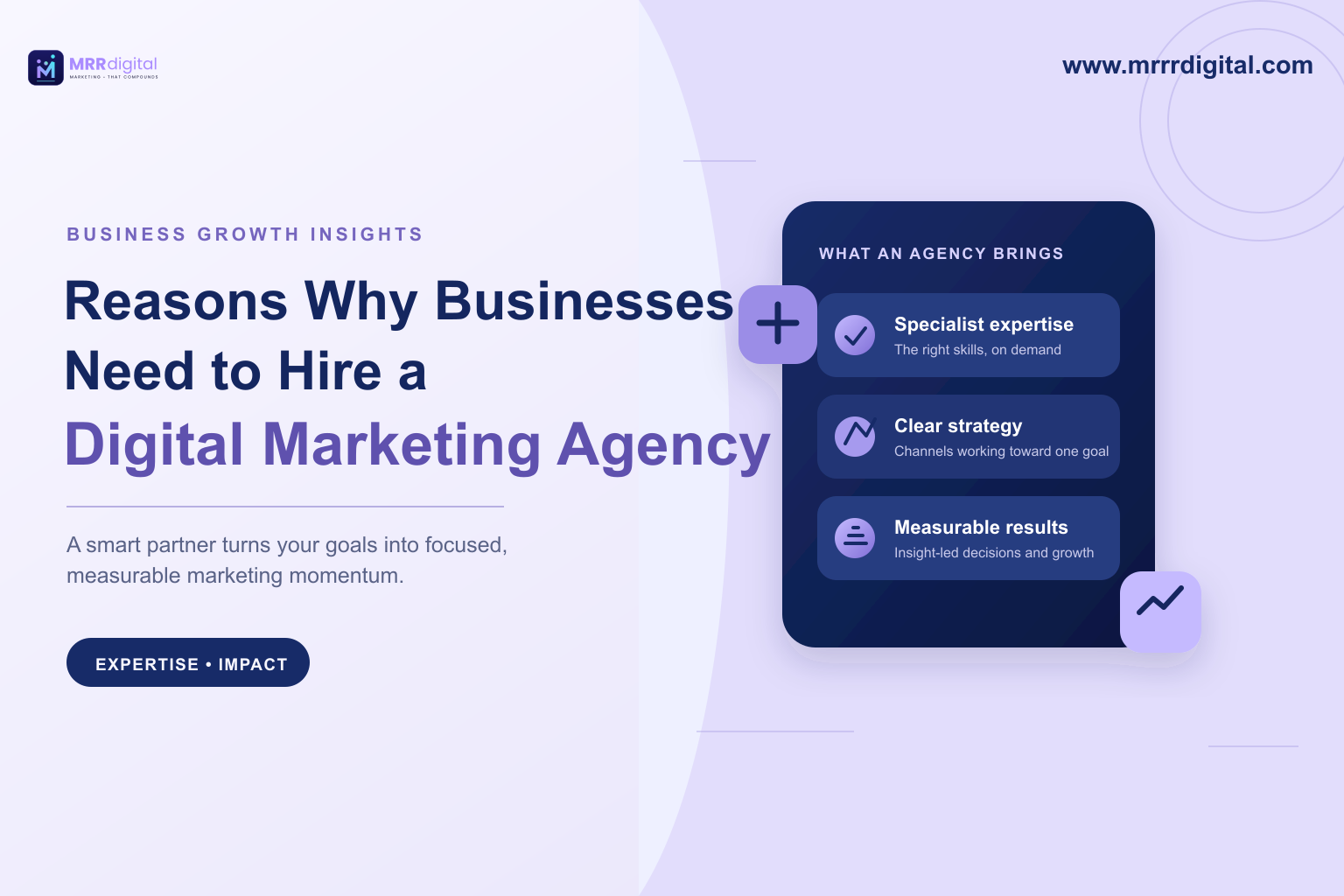
Businesses hire a digital marketing agency to get specialist skills across many channels without building a full in-house team. The main reasons are:
- Broader expertise: SEO, paid ads, email, social, analytics and AI tools under one roof.
- Faster start: a working team in weeks, not the months it takes to recruit.
- Cross-industry experience: an agency has seen what works and fails across many accounts.
- Flexible cost: you can scale effort up or down instead of carrying fixed salaries.
- Objective measurement: an outside team has no reason to flatter the numbers.
- Keeping up with change: search, social and ad platforms change constantly, and that is the agency’s full-time job.
What has changed in digital marketing in 2026
Three shifts explain most of the demand for outside help.
- Fewer searches end in a click. A SparkToro study using Similarweb data, reported by TechWyse, found that 68% of U.S. Google searches ended without a click in early 2026. The same study found that when an AI Overview appeared, organic clicks fell 38%.
Other analyses point the same way. Ahrefs reported in May 2026 that AI Overviews were associated with a 58% lower average click-through rate for top-ranking pages, up from 34.5% in its earlier study. Seer Interactive’s data, covered by Search Engine Land, puts organic CTR at roughly 3.3% for searches with no AI Overview and about 0.9% for those with an AI Overview that doesn’t cite you.
A caveat worth keeping in mind: these studies use different methods, and Google itself has argued that links inside AI Overviews perform well. The direction is consistent, though. Ranking alone is no longer enough.
- AI is now standard equipment. HubSpot’s 2026 State of Marketing report, a survey of more than 1,500 marketers, found that only 1.7% don’t use AI and don’t plan to. Using AI to create personalised content was the top trend. Since everyone has the same tools, the tools themselves no longer set a brand apart.
- Data quality is the weak link. In the same HubSpot survey, just 65% of marketers said they have high-quality audience data, a figure that hadn’t moved from the year before. AI is only as good as what it’s fed.
10 reasons to hire a digital marketing agency
1. Search now has more than one front door
People still use Google, but they also ask AI assistants, scroll TikTok and Instagram, and read Reddit threads before they buy. Each surface has its own rules for being found.
An agency can cover these in one plan. Without that, businesses tend to over-invest in one channel and go quiet everywhere else.
2. SEO has a new companion: AEO and GEO
Two newer terms are worth knowing:
- AEO (answer engine optimisation): shaping content so it’s chosen as the direct answer in featured snippets, voice results and AI summaries.
- GEO (generative engine optimisation): making your brand likely to be cited or recommended inside AI-generated responses from tools like ChatGPT, Gemini and Perplexity.
Why it matters: Seer’s 2026 data, reported by TechWyse, showed that brands cited in AI Overviews earned a 15.74% paid click-through rate on the same queries, compared with 11.19% when they weren’t cited. Being named by the AI seems to help even the ads.
Seer’s numbers also show that AI Overviews appear far more often on comparison and question-style searches (roughly 95% and 86% of those queries) than on transactional ones (about 5%). A good agency uses that to decide where to chase AI visibility and where to focus on classic rankings and ads.
In practice, AEO and GEO come down to clear answers, solid structured data, consistent brand mentions across trusted sites, and content that shows real experience. It is detailed, technical work that rewards specialists.
3. AI makes production cheap and judgment scarce
Anyone can generate 50 blog posts this afternoon. Almost none of them will help. Google’s guidance asks for people-first content: useful, original, written from real knowledge.
A good agency uses AI for speed on research, drafts, variations and reporting, then adds the parts software can’t: your brand voice, your customer insight, a point of view and an editor who deletes the bland paragraphs. Ask any agency you’re considering exactly where AI is used and where a human signs off.
4. Paid ads are more automated, so inputs matter more
Platforms now push advertisers towards automated formats such as Google’s Performance Max and Meta’s Advantage+. The machine handles bidding and placement. What it can’t do is decide your offer, your audience signals, your creative or what counts as a conversion.
Poor inputs lead to expensive, confident-looking waste. Agencies that manage many accounts learn quickly which setups feed these systems well. Seer’s data also suggests paid search has been steadier than organic through the AI Overview shift, which makes it a useful counterweight while organic traffic patterns settle.
5. Social media rewards consistency and craft
Social feeds favour short video, fast trends and regular posting. That means scripting, filming, editing, community replies and testing. It’s a production line, not a side task for whoever has a free hour.
An agency brings a team that already works this way: strategist, designer, editor and analyst. For smaller businesses, that’s often the first time social media gets the attention it needs.
6. Email and automation compound over time
Email is one of the few channels you fully own. Industry surveys from Litmus and others, widely repeated, put average returns at around $36 to $42 per $1 spent. Treat that as a vendor-reported benchmark rather than a promise, since results vary by list quality and industry.
What’s less debatable is that the gains usually come from setup: welcome flows, abandoned-cart reminders, segmentation and re-engagement. A marketing automation specialist builds these once, tests them, and lets them run. Many businesses have the software but only two or three basic automations switched on.
7. Influencer marketing is bigger, and messier
Influencer Marketing Hub estimates the industry reached about $32.55 billion in 2025, and most of the marketers it surveyed expected to spend more in 2026. Estimates differ by source, so treat the exact figure as a rough guide.
The trend inside the trend is a move to smaller creators. Reported Instagram engagement for micro-influencers (10K to 100K followers) averages around 3.86%, compared with about 1.21% for mega-influencers.
But finding the right creator, checking for fake followers, negotiating usage rights and measuring sales is slow, and it’s where inexperienced brands lose money. Agencies have relationships, contract templates and tracking methods already in place.
8. Measurement is harder, and someone has to be honest about it
Clicks no longer tell the whole story. Some customers see you in an AI answer, then search your name later. Others see a creator video and buy a week afterwards.
An agency can set up proper tracking, connect ad platforms to your sales data and report on what produced revenue, not just traffic. Because they sit outside your team, they can say “this channel isn’t working” without internal politics.
9. You get a team for the price of fewer hires
A complete in-house team needs an SEO specialist, a paid media buyer, a content writer, a designer, an email person and an analyst, plus the software they use. For most businesses that’s out of reach. An agency spreads those costs across clients, so you pay for the share you use.
10. You get your own time back
For owners and small teams, marketing often competes with everything else on the to-do list. Handing it to people accountable for results lets you focus on product, service and customers.
What this means for small, medium and large businesses
The reasons above apply to everyone, but the emphasis differs.
Small businesses usually need focus more than breadth. A good agency will pick two or three channels, often local SEO, a Google Business Profile, a simple paid campaign and an email list, and do them properly. It’s the quickest way to get professional marketing without a full-time salary. Be wary of any agency that wants to do everything for a tiny budget.
Medium-sized businesses are often stuck between a one-person marketing team and a growing list of channels. Agencies fill specialist gaps (technical SEO, paid media, automation, analytics) and let the internal team concentrate on strategy and brand. This is also where setting up proper tracking tends to pay for itself.
Large businesses rarely hire agencies because they lack staff. They do it for speed, specialist depth, international reach or an outside view. Typical examples are a launch that needs a surge of capacity, a GEO audit across many markets, or a creative team for campaigns. Clear governance matters here: shared dashboards, defined responsibilities and an agreed process for brand approvals.
Conclusion
Digital marketing in 2026 asks more of businesses than it used to. Search is shared with AI answers, social platforms demand a steady stream of video, ads are increasingly automated, and customers move between channels before they buy.
A good agency doesn’t replace your understanding of your customers. It adds the breadth, tools and tested habits that are hard to build alone, and it holds the work accountable to real results. Hire one when you have a clear offer, realistic goals and a willingness to share information openly. Then judge them on outcomes, not activity.
Frequently asked questions
What does a digital marketing agency do?
It plans and runs online marketing on your behalf. That typically includes SEO, paid advertising, social media, email, content, analytics and, increasingly, optimisation for AI-generated search answers.
Is a digital marketing agency worth it for a small business?
Often yes, if the scope is narrow and the goals are clear. A small business can get professional work on its two or three most important channels without the cost of a full-time hire. If the budget is very limited, a freelancer may be a better fit.
Should I hire an agency or build an in-house team?
Agencies suit businesses that need several specialist skills, want a quick start or have changing needs. In-house teams suit businesses with steady, large workloads and deep product knowledge. Many companies combine the two: an internal lead plus agency specialists.
How long does it take to see results?
It depends on the channel. Paid ads can produce traffic within days, though they usually need weeks of testing to become efficient. SEO, content and AI-search visibility generally take months. Be cautious of anyone who promises a fixed timeline.
What is the difference between SEO, AEO and GEO?
SEO helps your pages rank in traditional search results. AEO helps your content get chosen as a direct answer in snippets, voice results and AI summaries. GEO aims to get your brand cited or recommended inside AI-generated responses. They overlap and work best together.